

Monthly Archive for September 2010

WITHOUT A MASK

And in this decaying world, the worst is to be spineless and to have no personality. It is a world full of people who complain and who live grey and empty existences. People who do not have the courage to resist, to have their own thoughts and get dragged by the crowd. It is hard to live in this herd if you are not like them, if you know what you think, if you are not scared to say what you think, and if you do not care about not being accepted by others. Then you don’t fit in, you are different, you are radical.
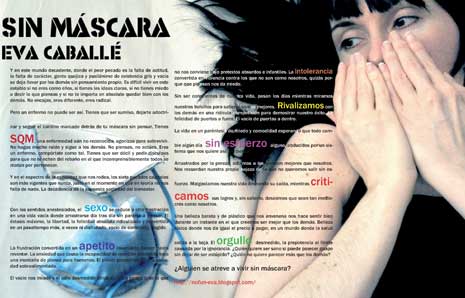
But an ill person cannot be like that. You have to be well-behaved, let yourself be brain-washed and follow the established road wearing a mask without thinking. If you have Multiple Chemical Sensitivity, an illness that is not recognized, you fight to survive. But don’t make too much noise and just follow others. Don’t think, don’t do. You are sick. Behave as such. You have to be obedient and ask for permission so that you will not be thrown out of the herd, a herd for which others kill themselves to be a part of.

And in the ignorance that surrounds us, the seven capital sins are more relevant than ever, in these times when there seems to be a theory for just about everything. In these times of the decaying Welfare State.

With the senses numbed, SEX becomes another frustration in an empty life in which to drag him or herself day after day without stopping to think.

It is a life with the frustration that becomes an unsatisfied HUNGER. Eat until you burst. That anxiety which impedes one from reacting and keeps one squashed under a mountain of human feed. The perverted pleasure in an overfed society.

An emptiness that invades us and a growing hate which turns into anger against all that does not suit us under childish and ridiculous excuses. INTOLERANCE becomes violence against those who are not like us, perhaps because those who think scare us.

Without being conscious of our lives, the days go by while we look at our pockets to see if we are better than others. We COMPETE in a silly race to show our success. We pretend we are happy. Inside, we are empty.

Life is a parenthesis of fear and of superficial comfort waiting for things to change WITHOUT MAKING AN EFFORT, sucked in by a system that wants us not to think.

We are dragged by laziness. We hate those who we think are better than us. They remind us of our not wanting to make an effort. We waste our lives wishing that they would stumble while we CRITIZICE their successes and, without knowing it, we wish they were as mediocre as us.

A cheap plastic beauty poisons us, one that makes us feel better for a moment in which we think we are better than others. A toxic beauty for which we don’t care the price we pay in a world where real health is not valued. Enormous fake PRIDE, the arrogance caused by ignorance. Who wants to be healthy if one can seem beautiful even if being stupid? Who does not want to seem better than others?

Does anyone dare to live without a mask?

Author: Eva Caballé, No Fun Blog, September 2010

Photos: Aida / Deliro

German Translation: Ohne Maske

More articles written by Eva Caballé:

International Conference: Environmental and chemical pollution cause health injuries and disabilities

Daily chemical exposures at low doses can affect our health

ROME – On September 24, 2010, from 8:30 a.m. to 5:30 p.m., the congress “New Environmental Diseases” was held at the Chamber of Deputees Congress Hall in Rome. The event was organized by A.M.I.C.A. (Association for Environmental and Chronic Toxic Injury), the Italian organization that works for the rights of people with MCS and EHS, and it was supported by Mep Domenico Scilipoti, an oncologist, holistic doctor, and rapporteur of a draft to become law on environmental diseases and disabilities and also for the phasing out of dental amalgam.

“More and more scientific evidence shows how daily chemical exposures at low doses can affect our health. With this event we would like to create a bridge between science and politics in order to have a new legislation, particularly for the protection of those affected by Multiple Chemical Sensitivity, Electromagnetic Hyper Sensitivity, Chronic Fatigue Syndrome and Fibromyalgia. These diseases seem to be correlated one to another,” Francesca Romana Orlando, Vice President of A.M.I.C.A., commented. She has just published the book Il Cerchio Perfetto (The Perfect Circle) about the link between industry, politics, academics, and media and its role in the hiding of toxic dangers to the public.

“Just a few weeks ago, at the Senate Commission for Health, the debate about the draft to become law for the recognition of MCS as an epidemic disease started. The prevalence of this illness is about 10% of the population and in Italy the patients still don’t have any hospital to receive any medical treatment in a proper environment,” Silvia Bigeschi, Vice President of A.M.I.C.A., adds.

There are ten projects to become law for the recognition of MCS as an epidemic disease at the Italian Parliament and, just the day before of the congress, A.M.I.C.A. presented a petition with more than 10,000 signature asking for the approval of a law for MCS and also a petition to the Ministry of Health for the total phase out of dental mercury (amalgam), since many cases of MCS, CFS and EHS seem to be triggered by amalgam fillings.

The congress was divided in four sessions. The first one was about “Diagnostic approaches” for MCS, CFS and FM. Prof. Giuseppe Genovesi of the University of Rome La Sapienza and Dr. Chiara De Luca, Head of the Laboratory BILARA at the Dermatological Institute Immacolata of Rome, presented the results of a study on oxidative stress and genetics in MCS patients, that was recently published on Toxicology Applied Pharmacology (Apr. 26, 2010).

While Dr. De Luca focused on the clear evidence of oxidative stress in these patients, such as the lack of enzyme catalysis and GST, Prof. Genovesi stressed the fact that the results don’t show the prevalence of one specific genetic polymorphism, but most of the patients had one or more genetic factors inducing a lower detoxification. He also announced that they are going to test the genetic predisposition of the enzyme catalysis, since this is so typically low in MCS patients.

Dr. Alberto Migliore, the chief of Rheumatology Department at the S. Pietro Fatebenefratelli Hospital in Rome, published a study about the comorbidity of MCS and Sjogren Syndrome. Dr. Lorenzo Bettoni presented a lecture about the environmental causes of CFS and FM, with an hypothesis about the role of chemicals, EMF pollution, and physical/mental stress on the triggering of these illnesses.

Dr. Giacomo Rao, who works for the Italian National Insurance of Workers (INAIL, the public institute that gives compensation and pension to the workers injured at workplace), talked about the legal aspects of the recognition of these illnesses as a disability. He showed that there are several impact life factors to consider and that in Italy there are now many MCS disability certificates, even if it is always very difficult to convince the commissions about the severity of this illness. He added that the final judgment depends only on the good will of the commissioners to study a new issue.

In the second session entitled “New Paradigms of Toxicology and Environmental Medicine,” Martin L. Pall, Professor Emeritus of Biochemistry and Basic Medical Sciences, Washington State University, presented his theory about the biochemical vicious cycle ON/ONOO – induced by the combination of high NOS activity and Tetrahydrobiopterin (BH4) depletion – and how it is able to explain not only MCS, CFS or FM, but also other emerging neuro-degenerative illnesses such AD, Parkinson or ALS. He commented that the De Luca – Genovesi study about oxidative stress represents a full confirmation of his theory.

Dr. Peter Ohnsorge, President of the European Academy for Environmental Medicine (EUROPAEM), has already applied Pall’s theory to his clinical approach in order to reduce NMDA in the cerebral metabolism. He proceeds in treating inflammation first, by supplementing enzymes, antioxidants, minerals and Vitamins. Then, he offers a chelation therapy, when possible, and also hemapheresis (Membrane Differential Filtration), gut therapy and detoxification. He also uses sauna therapy since the heat helps to increase BH4 and to oppose the vicious NO/ONOO cycle.

Recently, Dr. Ohnsorge was commissioned by the German Ministry of Health and Social Affairs, to do a controlled randomized study about the efficacy of therapies for MCS patients with the double aim of detoxification of lipophilic toxins and improving the complaints. He found out that using a complex therapeutic regime usually allows the patients to recover slowly, but surely.

The MCS people in the audience asked him several questions, for example about the bad secondary effects of supplementation of glutathione (GSH) and about the tests of compatibility of drugs and dental materials. He explained that supplementation has to be given always with very low doses at the beginning in order to avoid violent breaks in the detoxification mechanisms. Moreover, he suggested using the Lymphocyte Transformation Test (LTT) to find out reactions to drugs, metals, plastics and environmental toxins, while the basophil degranulation test is suggested when inflammation is suspected induced by metals, like in the case of titanium implants.

In the same second session, Dr. Ernesto Burgio, Coordinator of the Scientific Committee of ISDE Italia (Doctors for the Environment), gave a lecture about the epigenetic damages caused by environmental toxins and EMFs. The epigenome represents the interface between the information from the environment and the genome, and even in the absence of chromosomal or gene mutations, there still can be a change in the expression of the gene (DNA Methylation) because of an epigenetic injury. “With a few exceptions, cellular differentiation almost never involves a change in the DNA sequence itself,” commented Dr. Burgio.

Since the environment changed too quickly in the latest decades, the capacity of adaptation of the (epi) genome is not enough to compensate it. Thus, a toxic exposure from the parents, in the womb, or during the early childhood can induce a chronic disabling illness later in life.

New studies are being explored on how a lead exposure in infants can be associated to Alzheimer’s disease (AD)-like symptoms years later or how the mother’s exposure to high levels of folic acid, vitamin B12 or to cigarette smoke can induce epigenetic changes that can repress gene transcription and, then, induce phenotypes of asthma (i.e. allergic airway inflammation) in the offspring. These findings could lead to the conclusion that our society is on the edge of a “disevolution.”

In the third section on “Heavy Metals Toxicity,” Dr. Raimondo Pische, President of the International Academy of Bio-Dentistry (AIOB) talked about the risks associated with the exposure to the metals of dental amalgam. In particular, he presented a video of an amalgam fillings showing how mercury vapors are easily released by the amalgam. He underlined the fact that the dentists are the first ones at risk when they pose and remove amalgam fillings and that dental mercury represents the main source of exposure to mercury vapors in not occupational environments. This is no longer acceptable since mercury is the most toxic element in nature after the radioactive elements.

Dr. Antonello Maria Pasciuto, Italian member of the European Academy for Environmental Medicine (EUROPAEM), talked about the LTT-MELISA, the Lymphocyte Transformation Test for the proof of late allergy to metals (type IV). This kind of allergy was observed in patients with MCS, CFS, MS, FM, ALS and autoimmune diseases and it usually improves, as well as the symptoms, after the safe removal of dental metals.

Dr. Gianpaolo Guzzi of the Italian Organization for the Research on Metals and Biocompatibility (A.I.R.M.E.B.) talked about the side effects of chelation therapies. His group studied hundreds of patients with amalgam toxic load and they reviewed the effects of EDTA, DMPS, DMSA and Glutathione. EDTA seems to redistribute metals without really getting rid of them, while DMPS seems more effective on treating elemental mercury, but with severe side effects in some cases. DMSA works to detoxify from methyl mercury and it can also get rid of elemental mercury stocked in the kidneys. Recently Dr. Guzzi’s research group is testing the efficacy of Glutathione in metal detoxification since there aren’t studies about it.

In the last session about “EMF and Health”, Dr. Fiorenzo Marinelli, researcher of the Institute of Molecular Genetics (IGM) in Bologna talked about wireless technologies such as mobile phones, Wi-Fi and Wi-Max. He pointed out the fact that thermal effects are only a part of the biological effects of EMFs, but still these are the only ones considered by international safety standard limits. There are also other effects induced by the signal information in itself. This explains why, even though UMTS has usually a lower intensity of the signal compared to GSM, it uses a wider band of frequencies, then involving a greater risk of damage in the DNA, as the recent European Reflex study showed. His research group has recently studied the effects of radars and Wi-Fi and the preliminary findings show that both these kind of EMFs promote cell proliferation (2010).

Since scientific literature clearly demonstrates that EMF in our everyday life can induce DNA breakage, genetic deregulation as well as chromosomal breakage, increase of free radicals, alteration of neurotransmitters, memory loss, hypersensitivity-allergy, aging and possibly cancer, Dr. Marinelli supports the reduction of the safety limit of exposure to 0,6 V/m, as requested by the International Commission for the Electromagnetic Safety (ICEMS) since 2002.

Finally, Prof. Olle Johansson, associate professor at The Experimental Dermatology Unit – Department of Neuroscience of the Karolinska Institute, and Professor at The Royal Institute of Technology, Sweden, also member of the famous Bioinitiative Working group, presented a lecture about Electro-Hyper-Sensitivity, which is fully recognized as a functional impairment in Sweden. He explained not only the bioeffects of EMF on EHS people, but also the social problem of disability in our modern societies. “Disability is everywhere and it can happen to anyone: I myself have a disability when I am in Italy because I can not speak Italian,” Prof. Johansson commented. He reminded that all modern democracies signed international equal rights UN treaties, but still they leave these principles un-realized when it comes to environmental disability.

Reference:

A.M.I.C.A. congress shows how environmental and chemical pollution cause health injuries and disabilities, Rome, September 25th, 2010

Photo: AMICA

Contact:

Francesca Romana Orlando
Vice President of AMICA
Associazione Malattie da Intossicazione Cronica e/o Ambientale
(Association for Environmental and Chronic Toxic Injury)
P.O. Box 3131, 00121 Rome – Italy
www.infoamica.it amica(at)infoamica.it

Related articles:

Gloss: Electric Shock, the Treatment of Choice for MCS

The CSN-Blog recently received an email from the Danish Research Center for chemical sensitivity. Their communications director a journalist, wrote on behalf of the Director of Research. The email read as a glossy promotional brochure for the research center. They felt, they have to correct the public’s wrong impression about the work of this institution at the Copenhagen University Hospital Gentofte due to the posts written on the Canary Report and the CSN-Blog. However, at the same time, the Center wishes no publication of these corrections. The research center did not have the resources to devote to long debates on the internet, and are not interested in allowing their email to be published.

OK, as you like! We do not correct anything for the Center, and still think that that ECT, Electroconvulsive Therapy (the application of electric shocks) for those with MCS and other illnesses is totally inappropriate. Thus we cannot share how the Center uses this therapeutic approach in their work. But since the Center chose to touch in this unsavory theme, there will be a stigma associated with them indefinately.

ECT is a serious intentional physical injury and will be banned some day as such. The scientific community and organizations are working internationally to make sure this is indeed the case. ECT is nothing more than an electrical lobotomy and was seen similar by those who applied it in the early days. See P.R. Breggin, “Electroshock: Scientific, Ethical, and Political Issues” in the International Journal of Risk & Safety in Medicine 11 (1998), p. 20:6  The Brain-disabling Principle, and “Disturbing News for Patients and Shock Doctors Alike.”

The conclusions drawn by the Research Center from the application of ECT for those with MCS is little wiser than the diagnosis of a researcher in the following brutal joke: “A scientist cut off one leg of a frog and tells him to jump, “Go little frog, jump!” The poor animal does it. Even with two missing legs the frog attempts his best jump. When the frog with no legs cannot jump, the researchers determined that the frog is deaf.”

It does not make much more sense to infer that ECT has a positive effect on any disease. It damages the brain of those affected and thus they cannot then complain about their suffering or “be nuts.” By this, MCS suddenly gets at least partially “reversible”, alas only temporarily. What a miracle! Why bother discussing complex avoidance strategies, protective masks, healthy diets and the like, if it can be done so easily? It only takes a few electrical shocks from time to time and the sick will obey. How about the application of a stick instead? Still there is so much effort given to research the thereapeutic effects of ECT and how it exactly works. A stick works more reliably and if you hit only on the bare bottom, brain damage can be mostly excluded.

The Center’s email offered to answer any questions privately. We prefer to do without!

Author: BrunO for CSN – Chemical Sensitivity Network

Translation: Thanks to Christi Howarth

German Article: Glosse: Elektroschock, Therapie der Wahl bei MCS

Series:  “The Danish MCS Research Centre in the International Field of Vision”

Environmental factors and their influence on the progression of multiple sclerosis

A $634,000 grant from the Department of Defense is allowing researchers at the University at Buffalo to investigate a trio of environmental factors and their influence on the progression of multiple sclerosis.

The two-year project, headed by Murali Ramanathan, PhD, tests the hypothesis that nicotine metabolism, the byproducts of vitamin D metabolism and increased levels of anti-Epstein-Barr virus (EBV) each interact with variations in specific genes to cause increased neurodegeneration and increased lesions in MS patients.

Ramanathan is a professor of pharmaceutical sciences and neurology in the School of Pharmacy and Pharmaceutical Sciences and the School of Medicine and Biomedical Sciences, respectively.

The study is a collaboration between the UB and investigators from Charles University in Prague, Czech Republic, and will be conducted on samples obtained at both universities’ MS centers.

The research aims to identify gene-environmental interactions between key molecules in the vitamin D pathway, anti-Epstein-Barr virus antibodies, cigarette smoking and key genetic variants that are implicated in conversion of patients with clinically isolated syndrome (CIS) to definite MS.

They will assess the risk of developing clinically definite MS and the time to progression, as well as the neurodegeneration in the brain of MS patients, as measured by brain atrophy, and the extent of brain injury caused by lesions.

“We will use a novel approach to measure the levels of vitamin D and its metabolites, EBV exposure and nicotine metabolites from cigarette smoking,” says Ramanathan. “We have developed sensitive and selective measurements for key metabolites in the vitamin D and nicotine metabolism pathways using mass spectrometry, a method that has not been used previously to study vitamin D metabolism.

The novel study design will include the genetic variations that were associated with the risk of developing MS, as well as genes that determine the levels and responses to environmental factors. MS patients will be divided into two equal groups: a training group that will be used to identify gene-environmental interactions, and a group that will be used to replicate the training group result.

“Identifying gene-environmental interactions is critical for developing better strategies for slowing the progression of MS, because it could enable patients with preexisting genetic risk factors to reduce the rate of disease progression through lifestyle modification,” Ramanathan says.

The study results will identify the gene-environment interactions that promote disease progression in MS and facilitate the development of preventive and therapeutic interventions for MS that disrupt these interactions, notes Ramanathan.

Bianca Weinstock-Guttman, MD, Robert Zivadinov, MD, PhD, and Jun Qu, PhD, all of UB, are study co-principal investigators. Dana Horakova, MD, PhD, and Eva Havrdova, MD, PhD, are collaborators at Charles University in Prague.

The University at Buffalo is a premier research-intensive public university, a flagship institution in the State University of New York system and its largest and most comprehensive campus. UB’s more than 28,000 students pursue their academic interests through more than 300 undergraduate, graduate and professional degree programs. Founded in 1846, the University at Buffalo is a member of the Association of American Universities.

Reference: University at Buffalo, Study to Look at Environmental Factors, MS Progression, September 21, 2010.

Researchers renew call for governmental agencies to identify all products with BPA

New Study Indicates Higher than Predicted Human Exposure to the Toxic Chemical Bisphenol A or BPA

COLUMBIA, Mo. – Researchers have discovered that women, female monkeys and female mice have major similarities when it comes to how bisphenol A (BPA) is metabolized, and they have renewed their call for governmental regulation when it comes to the estrogen-like chemical found in many everyday products.

A study published online in the Sept. 20 NIH journal Environmental Health Perspectives ties rodent data on the health effects of BPA to predictions of human health effects from BPA with the use of everyday household products. The study was authored by researchers at the University of Missouri Division of Biological Sciences, Veterinary Medical Diagnostic Lab (VMDL) and the department of Biomedical Sciences, in collaboration with scientists at the University of California-Davis and Washington State University.

“This study provides convincing evidence that BPA is dangerous to our health at current levels of human exposure,” said Frederick vom Saal, Curators’ professor of biological sciences at the University of Missouri. “The new results clearly demonstrate that rodent data on the health effects of BPA are relevant to predictions regarding the health effects of human exposure to BPA. Further evidence of human harm should not be required for regulatory action to reduce human exposure to BPA.”

BPA is one of the world’s highest production-volume chemicals, with more than 8 billion pounds made per year. It can be found in a wide variety of consumer products, including hard plastic items such as baby bottles and food-storage containers, the plastic lining of food and beverage cans, thermal paper used for receipts, and dental sealants. The findings in the current study suggest that human exposure to BPA is much higher than some prior estimates and is likely to be from many still-unknown sources, indicating the need for governmental agencies to require the chemical industry to identify all products that contain BPA.

Several states, including Connecticut, Massachusetts, Washington, New York and Oregon, have passed bills to reduce exposure to BPA, and similar legislation is pending in the U.S. Congress.

“For years, BPA manufacturers have argued that BPA is safe and have denied the validity of more than 200 studies that showed adverse health effects in animals due to exposure to very low doses of BPA,” said Julia Taylor, lead author and associate research professor at the University of Missouri. “We know that BPA leaches out of products that contain it, and that it acts like estrogen in the body.”

“We’ve assumed we’re getting BPA from the ingestion of contaminated food and beverages,” said co-author Pat Hunt, a professor in the Washington State University School of Molecular Biosciences. “This indicates there must be a lot of other ways in which we’re exposed to this chemical and we’re probably exposed to much higher levels than we have assumed.”

The research team at the University of Missouri includes Taylor, vom Saal and student researcher Bertram Drury in Biological Sciences, as well as Wade Welshons in Biomedical Sciences and George Rottinghaus in the VMDL at MU.

Reference:

University of Missouri, New Study Indicates Higher than Predicted Human Exposure to the Toxic Chemical Bisphenol A or BPA, September 20th, 2010.

Related articles: