Mount Sinai finds prenatal exposure to certain chemicals affects childhood neurodevelopment


A new study led by Mount Sinai researchers in collaboration with scientists from Cornell University and the U.S. Centers for Disease Control and Prevention, has found higher prenatal exposure to phthalates—manmade chemicals that interfere with hormonal messaging—to be connected with disruptive and problem behaviors in children between the ages of 4 and 9 years. The study, which is the first to examine the effects of prenatal phthalate exposure on child neurobehavioral development, will be published January 28, on the Environmental Health Perspectives website.

“There is increasing evidence that phthalate exposure is harmful to children at all stages of development,” said Stephanie Engel, PhD, lead study author and Associate Professor of Preventive Medicine at Mount Sinai School of Medicine. “We found a striking pattern of associations between low molecular weight phthalates – which are commonly found in personal care products – and disruptive childhood behaviors, such as aggressiveness and other conduct issues, and problems with attention. These same behavioral problems are commonly found in children diagnosed with Attention-Deficit Hyperactivity Disorder (ADHD), Oppositional Defiant Disorder, or Conduct Disorder.”

Phthalates are part of a group of chemicals known as endocrine disruptors, that interfere with the body’s endocrine, or hormone system. They are a family of compounds found in a wide range of consumer products such as nail polishes, to increase their durability and reduce chips, and in cosmetics, perfumes, lotions and shampoos, to carry fragrance. Other phthalates are used to increase the flexibility and durability of plastics such as PVC, or included as coatings on medications or nutritional supplements to make them timed-release.

“Recently, the government instituted regulations limiting certain phthalates in things like child care articles or toys that a young child might put in their mouth,” continued Dr. Engel. “But it’s their mother’s contact with phthalate-containing products that causes prenatal exposure. The phthalates that we found most strongly related to neurodevelopment were those commonly found in cosmetics, perfumes, lotions and shampoos. Current US regulations do not address these kinds of phthalates.”

For the study, phthalate metabolite levels were analyzed in prenatal urine samples of a multiethnic group of 404 women who were pregnant for the first time. The women were invited to participate in follow-up interviews when their children were between the ages of 4 and 9. The mothers were not informed of their phthalate metabolite levels and the researchers were unaware of their exposures when testing the children.

Follow-up visits were completed by 188 of the women and their children. At each follow-up visit, the mothers completed validated questionnaires designed to assess their behavior and executive functions. The researchers found that mothers with higher concentrations of low molecular weight phthalates consistently reported poorer behavioral profiles in their children. The strongest trends were in the categories of conduct and externalizing problems, characteristics typically associated with Oppositional Defiant Disorder, Conduct Disorder and ADHD.

“These are high level, chronic exposures that start before the child is even born, but continue throughout their life. More research is needed to examine the effects of cumulative exposure to phthalates on child development. But what this study suggests is that it’s not enough to regulate childhood exposure to these chemicals. The regulations need to include products that moms use,” said Dr. Engel.

Reference: The Mount Sinai Hospital / Mount Sinai School of Medicine, Mount Sinai finds prenatal exposure to certain chemicals affects childhood neurodevelopment, Jan. 28, 2010

Open Letter: Perfumed Stamps Constrain People with Disabilities

Postage stamps with aroma could affect the health of sensitive people


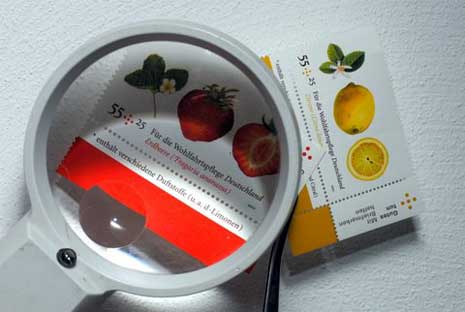
On January 7th, German Minister of Finance, Dr.Schaeuble, presented the new charity postage stamps to Federal President Horst Koehler and Ms. Donata Freifrau Schenck zu Schweinsberg, President of the Bundesarbeitsgemeinschaft der Freien Wohlfahrtspflege (a federal association of welfare organizations). The unique feature of these stamps for this year is: They are fruit scented – blueberry, strawberry, lemon and apple. The scenting agents are micro-encapsulated and are not supposed to be released until they are rubbed.

The perfumed stamps release a scent even without being rubbed

CSN wanted to know whether the stamps really do not smell until being rubbed and arranged to get samples of the scented stamps. As we asked to buy the new charity stamps, the lady behind the post office counter pulled out an extra folder and remarked almost devoutly, “Oh yes, this are the new perfumy stamps.” She took out a sheet of stamps which showed blueberries and delightedly announced: “Wow, these really can be smelled without rubbing!”

Two welfare stamps were purchased by CSN and examined carefully. Both stamps give off a smell without being rubbed with the finger. Strictly speaking, the strawberry-stamp emits the smell of a cheap toothpaste with strawberry flavor, and the odor of the lemon stamps are a reminder of a toilet cleaner with an artificial lemon aroma. It smells nothing like a natural fruit aroma. The lemon scent grew stronger after the stamp was left at room temperature for a short while. CSN refused to activate the odor by rubbing. It can be assumed that the smell of the stamps will grow by the inevitable friction of the letters during transport and by running them through the sorting system at the postal hubs. Therefore it is quite possible that the perfumed stamps will contaminate other mail.

CSN would like to know if the applied scents were tested for their health compatibility, and which safety criteria and methods they used for the tests. Was their safety criteria the tolerable toxic load for an average healthy adult or was it the tolerable toxic load for the weakest, i.e. for an embryo? Did they test the plain aroma agents or the printing ink equipped with the aroma? Has the material of the stamp an effect on the compatibility? The information of the Bundesdruckerei (German federal printing press) suggests that first amounts of the scents were emitted before even the printing process was completed.

People with asthma, allergy to scents, sensitivities to chemicals, and persons who respond severely to scents could be affected by this advertising stunt.

As an answer, at January 11, CSN wrote the following open letter:


Perfumed Postage Stamps Constrain People with Disabilities

Dear Mr. Federal President Dr. Horst Koehler,

Dear Ms. Frau Donata Freifrau Schenck zu Schweinsberg,

Dear Dr. Wolfgang Schaeuble,

On January 7th, you shared the presentation of the new charity stamps issued by the Ministry of Finance, which emit scents of apple, strawberry, blueberry and lemon when rubbed. We want you to think about that at first glance simpatico idea, and we politely request you Dr. Schaeuble, to withdraw these postage stamps from circulation as Minister of Finance, because there are groups of people with certain disabilities and health disorders, who would be at risk if exposed to these scents.

Wouldn’t it be ironic, if some of those people who should benefit from these charity stamps will be harmed, by putting them in circulation? Do you realize the critical position of the German Federal Environmental Agency (UBA/Umweltbundesamt) regarding scents? The UBA points out that scented products should be avoided in public areas. The German coalition for allergies and asthma the DAAB (Deutscher Allergie- und Asthmabund e.V.) assumes about 11 percent of general population, that was actually a good nine million cases, affected by olfactory hypersensitivity for scents (according to Meggs et al. 1996). They postulate warning signs for scented rooms.

Is it appropriate to characterize those as people with disabilities who respond to scents with health troubles?

According to the ‘Americans with Disabilities Act’ (ADA), an individual with a disability is defined as a person who has a physical or mental impairment that substantially limits one or more major life activities, a person who has a history or record of such an impairment, or a person who is perceived by others as having such an impairment.

The ‘Convention on the Rights of Persons with Disabilities’ (UN-convention) which was signed by the German government on March 30, 2007, defines persons with disabilities as those, who have long-term physical, mental, intellectual or sensory impairments which may hinder their full and effective participation in society on an equal basis with others.

Perfumed postage stamps limit the lifestyle of allergic, asthmatic, chemically diseased and other sensitive persons in an unreasonable way. This violates the UN-convention and does not meet the protection criteria set out for people with disabilities as outlined by the ADA. Severe sensitive cases and those who suffer from contact allergies caused by scents don’t even need to smell traces of those contaminants. Unsuspecting they will contaminate their living space which often is prepared safe from toxins under difficult financial conditions.

Thus far, people with health impairments from scents were able to at least receive and open their mail without help from others. This autonomy and normality of life is taken away from them. If someone encounters physical reactions by being exposed to scents, he/she will become unable to receive mail any longer and has to depend on other people to sort this type of ‘mail bomb’ out. Possibly a whole delivery is lost because one single letter with a perfumed postage stamp has contaminated all other mail.

During the Christmas season of 2004 there was a similar campaign with perfumed scratch stickers. Contrary to the statement of a German mail service personnel, the scents are not securely locked in the ink. None can be sure that somebody rubs the stamps on the dispatch or mechanical interaction will release these substances. At that time when the mail arrived it was already fragrant and it will be again this time.

Potentially such deliveries could sensitize people who have not suffered from an allergy yet. Have the applied scents adequately been tested for that risk? Would you bet your life on their harmlessness? Did you know that most of the scents used in Germany are not tested for tolerance? According to the “Special Report on Allergies, 2000″ (“Spezialbericht Allergien, 2000″) by the German Federal Government, there are about 15 to 25 percent of general population affected by an atopic disease, that was over 20 million cases, and one-third are sensitized for allergies, that was about 27 million. Should not everything be done, to keep this data from growing?

Scents trigger a variety of physical reactions for people with this sensitivity. Depending on disease and state of health, they range from harmless irritations to life threatening conditions. The following troubles can be caused individually or in combinations:

Tiredness, sneezing, irritated eyes, redness, itching, blisters, inflammations, swelling and burning of the lips, nasal mucosa burning, burning of the tongue, toothache, cough, voice failure, labored breathing, vertigo, sickness, headache, migraine, speech disorder, disturbance of memory, permanent painful vomiting, cardialgia, tachycardia, state of shock, absence, coma.

Often, such an incident increases the sensitivity for other substances or undoes a recovery which was hardly achieved by a strategy of avoidance and healthy living over a long period.

If nothing else, artificial scents could disturb the aesthetic perception of healthy ones and never reach the sensuality of their prototypes. Lay some apples from an organic farmer in your bedroom and compare it with the odor from these stamps.

Considering all of the above, we request, that the health damage which may be expected for those people in the general population who are sensitized by scents be recognized and, as under the terms of the Convention on the Rights of Persons with Disabilities, that the circulation of these perfumed postage stamps be immediately stopped.

Kind regards,

Silvia K. Mueller, Bruno Zacke

CSN – Chemical Sensitivity Network

—-

We thank Christi and Jim for translation help.

Long-term respiratory symptoms in World Trade Center responders

9/11 responders still sick


New York State (NYS) employees who responded to the World Trade Center (WTC) disaster on or after 11 September 2001 potentially experienced exposures that might have caused persistent respiratory effects. NYS responders represent a more moderately exposed population than typical first responders. 

To assess whether NYS employees who were WTC responders were more likely than controls to report lower respiratory symptoms (LRS) or a diagnosis of asthma 5 years post-9/11, persistence and severity of symptoms were also evaluated. 

Participants were initially mailed self-administered questionnaires (initial, Year 1, Year 2) and then completed a telephone interview in Year 3. Data were analysed using Poisson’s regression models. 

WTC exposure was associated with LRS, including cough symptoms suggestive of chronic bronchitis, 5 years post-9/11. When exposure was characterized using an exposure assessment method, the magnitude of effect was greater in those with exposure scores above the mean. WTC exposure was associated with persistence of LRS over the 3 year study period. Results also suggest that participants with the highest exposures were more likely to experience increased severity of their asthma condition and/or LRS. 

The findings suggest that even in a moderately exposed responder population, lower respiratory effects were a persistent problem 5 years post-9/11, indicating that some WTC responders require ongoing monitoring.  

Literature: Mauer MP, Cummings KR, Hoen R., Long-term respiratory symptoms in World Trade Center responders, Bureau of Occupational Health, Center for Environmental Health, New York State Department of Health, Occup Med (Lond). 2009 Dec 24.

Medicine needs Shift in Paradigm to focus on Environmental Medicine

Newspaper reports of chemically sensitive man

It took eight years until a doctor was able to make a correct diagnosis

The German newspaper Rheinische Post, one of the most noted papers in the Lower Rhine region, published an article about a man who hopped from doctor to doctor for eight years, until he finally got the right diagnosis. He responded to nearly all chemicals, even in lowest concentrations, which are almost omnipresent in everyday life. This was dismissed as mental problem for years. Then at last, the man from Rhineland received the proper diagnosis from a South-German physician: MCS – Chemical Sensitivity. If there was more focus on environmental medicine, cases like this current from the Rheinische Post, were avoidable.

Although he had physical troubles, he was told his problem was psychological

Ralf T. did a lot of sports until he developed more and more allergies. In addition to allergies, he experienced an increasing number of troubles, but no doctor could make a correct diagnosis and find the reason. The Rheinische Post lists the symptoms: “breathing problems, chronic fatigue, burn out, nausea, headache and many more”.

Cause of the disease: toxic adhesive

The graduate in sport science was a trainer in a fitness studio. An adhesive which was used to glue the flooring in his apartment ruined his health. It caused gas emissions of toxic chemicals which according to the Rheinische Post injured his immune system.

No help from the German obligatory health insurance

Now Ralf T. has to live in isolation and manage without money too. He would like to arrange his living environment to be toxic free to improve his health. But the attitude of the health insurance prevents such efforts. The Rheinische Post reports that the 52 year old wasn’t granted even basic things like a special bed. The insurance just hides behind regulations. There are no considerations what is indispensable to life for this man with environmental illness. He lacks any strength to resist.

Author: Silvia K. Müller, CSN – Chemical Sensitivity Network, January 4, 9010

Translation: BrunO

Italian Parties united under the MCS cause

Italy - Chemical Sensitivity - victims need help and protection

At the beginning of 2006 AMICA wrote to all the Members of Parliament asking for a law to recognize Multiple Chemical Sensitivity (MCS) as a Public Health Illness. The idea came after this kind of recognition was given to the Celiac Disease. If people with such severe food intolerance could have a special law for their problems, why shouldn’t MCS have the same, since it is so similar, widespread and life-limitating?

Paolo Cento from Parito dei Verdi (Green Party) replied and invited AMICA to work together in writing a law proposal. Thus, the first law for MCS was presented in June 2006, posing a first step towards the MCS recognition.

At that time three Regional Parliaments (Tuscany, Emilia-Romagna, Abruzzo) had already recognized MCS as a rare disease, but the doctors nominated by two Regional Administrations in the MCS Commission didn’t want to make diagnoses, claiming that “there isn’t enough evidence about MCS” Even though the existence of an International Consensus about MCS diagnostic criteria, they planned an observational study to find new criteria, so the ill people were in fact left without a proper diagnosis and treatment.

In the meantime, the Superior Institute for Health (ISS), a public health agency, created an inter-regional Commission aimed to prepare a position paper about MCS that the Supreme Council of Health (CSS), the scientific arm of the Ministry of Health, should then review and sign. In September 2008 the CSS released the final MCS document claiming that “MCS can not be recognized as an illness due to lack of evidence and the absence of an univocal diagnostic test”. MCS activists know well this old story.

The inter-regional ISS Commission paper, in fact, quoted several studies by researchers with industry ties and also the presumed WHO-IPCS consensus of Berlin in 1996. The famous book about MCS written by the major experts, Nicholas Ashford and Claudia Miller, clearly explain that there isn’t any WHO-IPCS Consensus.

Thus, AMICA wrote again to the Parliament Members asking for an investigation about the ISS and CSS position papers that didn’t consider important scientific references about MCS. The Member of Chamber of Deputies Giorgio Jannone asked to the Ministry of Health, with a parliamentary interpellation, why the inter-regional commission was made mainly by occupational doctors even if MCS is also a pediatric illness. There is still no answer.

Actually, the Italian occupational doctors were prohibited to make MCS diagnoses since 2005 when their professional organization released a strong anti-MCS position paper, claiming that to make MCS diagnoses and to study MCS is a waste of money and time.

The only hope for MCS recognition in Italy lays in the hands of politics and AMICA worked well with members from all the political parties. Today there are, in fact, five proposals by Partito della Libertà (Liberty Party) and four proposals by the opponent parties, Partito Domocratico (Democratic Party) and Italia dei Valori (the Italian Party of Values).

Only in December three new law proposals were presented. Among them, the one by On. Domenico Scilipoti (IdV) is quite new because it considers AMICA’s request for a more wide recognition of Environmental Illnesses and Disability. The law is addressed to those people whose survival and quality of life depend not much on drugs, but on avoiding certain environmental factors.

The most common Environmental Illnesses are: MCS, involving a loss of tolerance of chemicals; Electromagnetic Hyper-Sensitivity (EHS), forcing the affected ones to get far from electromagnetic fields emitted by mobiles, Wi-Fi, electric cables, etc.

Moreover, Fibromyalgia and CFS patients usually suffer from chemical intolerances and scientific evidence suggests that avoiding chemicals improve these conditions. Autism, epilepsy, migraine and lupus involve reactions to fluorescent lighting. But there are also several other conditions, even not originally caused by the environment, that present reactions to a certain environmental quality, such as the genetic favism, which causes serious reactions to legumes and forces the one affected to an avoiding protocol.

A representative of the Green Party of the Region Tuscany wrote today to AMICA to say that they will present this law proposal for Environmental Disability to the Regional Commission for Health and, hopefully, there might be a regional law as well.

Author: Francesca Romana Orlando, Journalist and Vice President of AMICA, 29th December 2009

Associazione Malattie da Intossicazione Cronica e/o Ambientale

(Association for Environmental and Chronic Toxic Injury)

www.infoamica.it


Related articles:

The links to the law proposals:

At the Chamber of Deputies

At the Senato