Archive for category ‘Chemical Exposure‘

Airway cells use ‘tasting’ mechanism to detect and clear harmful substances

Industry releases toxic fumes

The same mechanism that helps you detect bad-tasting and potentially poisonous foods may also play a role in protecting your airway from harmful substances, according to a study by scientists at the University of Iowa Roy J. and Lucille A. Carver College of Medicine. The findings could help explain why injured lungs are susceptible to further damage.  

The study, published online July 23 in Science Express, shows that receptors for bitter compounds that are found in taste buds on the tongue also are found in hair-like protrusions on airway cells. In addition, the scientists showed that, unlike taste cells on the tongue, these airway cells do not need help from the nervous system to translate detection of bitter taste into an action that expels the harmful substance. 

The hair-like protrusions, called motile cilia, were already known to beat in a wave-like motion to sweep away mucus, bacteria and other foreign particles from the lungs. 

The study is the first to show that motile cilia on airway cells not only have this “clearing” function, but also use the receptors to play a sensory role. The researchers also found that when the receptors detect bitter compounds, the cilia beat faster, suggesting that the sensing and the motion capabilities of these cellular structures are linked. 

“On the tongue, bitter substances trigger taste cells to stimulate neurons, which then evoke a response — the perception of a bitter taste. In contrast, the airway cells appear to use a different mechanism that does not require nerves,” said Alok Shah, a UI graduate student and co-first author of the study. “In the airways, bitter substances both activate the receptors and elicit a response — the increased beating of the cilia — designed to eliminate the offending material.”

Shah and co-first author Yehuda Ben-Shahar, Ph.D., an assistant professor of biology at Washington University who was a postdoctoral fellow at the UI when the study was conducted, worked in the lab of senior study author Michael Welsh, M.D. (photo, upper left), UI professor of internal medicine and molecular physiology and biophysics, who holds the Roy J. Carver Chair of Internal Medicine and Physiology and Biophysics. Welsh also is a Howard Hughes Medical Institute investigator. 

“These findings suggest that we have evolved sophisticated mechanisms to guard ourselves from harmful environmental stimuli,” Ben-Shahar said. “Our work also suggests that losing cilia in the lungs, due to smoking or disease, would result in a reduced general ability to detect harmful inhaled chemicals, increasing the likelihood of further damaging an injured lung.”

In addition to Ben-Shahar, Shah and Welsh, the UI team included Thomas Moninger, assistant director of the UI Central Microscopy Research Facility, and Joel Kline, M.D., UI professor of internal medicine. 

The study was funded by grants from the National Institutes of Health. 

Reference:   University of Iowa, Airway cells use ‘tasting’ mechanism to detect and clear harmful substances, July 24, 2009

Baby bathwater contains fragrance allergens and chemicals

Baby bathing - Watch out for Chemicals in Babybath

A group of chemists from the University of Santiago de Compostela (USC) has developed a method to quantify the fragrance allergens found in baby bathwater. The researchers have analysed real samples and detected up to 15 allergen compounds in cosmetics and personal hygiene products. 

A team of scientists from the Department of Analytical Chemistry, Nutrition and Bromatology at the USC has developed a method to detect and quantify the 15 most common fragrance allergens included in soap, gel, cologne and other personal hygiene products.   

“Applying the method to eight real samples obtained from the daily baths of a series of babies aged between six months and two years old, we discovered the presence of all the compounds under study in at least one of the samples,” co-author of the study published this month in Analytical and Bioanalytical Chemistry, María Llompart, explained to SINC. 

The scientists found at least six of the 15 compounds in all the samples. In some cases, concentrations were “extremely high”, exceeding 100ppm (parts per million = nanograms/millilitre). Some of the substances that appeared were benzyl salicylate, linalol, coumarin and hydroxycitronellal. 

“The presence and levels of these chemical agents in bathwater should be cause for concern,” Llompart said, “bearing in mind that babies spend up to 15 minutes or more a day playing in the bath and that they can absorb these and other chemicals not only through their skin, but also by inhalation and often ingestion, intentional or not.”

New Method to Detect Fragrances

Allergens were able to be detected due to the high level of sensitivity of the method, which for the first time applies the Solid-Phase Micro Extraction (SPME) technique to determining the ingredients of cosmetics and child hygiene products. This technique makes it possible to concentrate and isolate chemical components from a sample by absorbing them into fibres with a certain coating. 

The researchers have also employed gas chromatography to separate compounds and mass spectrometry to identify and measure the abundance of each of the fragrances. 

European regulations stipulate that the presence of such substances should be indicated on the label of the product when levels exceed a certain limit (0.1 or 0.01%, depending on the type of compound), but some associations believe these limits are excessively tolerant, particularly where child hygiene and baby and child care products are concerned. 

References: J. Pablo Lamas, Lucia Sánchez-Prado, Carmen Garcia-Jares y María Llompart. “Solid-phase microextraction gas chromatography-mass spectrometry determination of fragrance allergens in baby bathwater”. Analytical and Bioanalytical Chemistry 394 (5): 1399-1411, julio de 2009.

UCLA study reveals how tiny levels of carbon monoxide damage fetal brains

CO Exposure could make them more vulnerable to disease

A UCLA study has discovered that chronic exposure during pregnancy to miniscule levels of carbon monoxide damages the cells of the fetal brain, resulting in permanent impairment. The journal BMC (BioMed Central ) Neuroscience published the findings June 22 in its online edition.

“We expected the placenta to protect fetuses from the mother’s exposure to tiny amounts of carbon monoxide,” said John Edmond, professor emeritus of biological chemistry at the David Geffen School of Medicine at UCLA. “But we found that not to be the case.”

The researchers exposed pregnant rats to 25 parts per million carbon monoxide in the air, an exposure level established as safe by Cal/OSHA, California’s division of occupational health and safety.

Dr. Ivan Lopez, UCLA associate professor of head and neck surgery, tested the rats litters 20 days after birth. Rats born to animals who had inhaled the gas suffered chronic oxidative stress, a harmful condition caused by an excess of harmful free radicals or insufficient antioxidants.

“Oxidative stress damaged the baby rats brain cells, leading to a drop in proteins essential for proper function,” said Lopez. “Oxidative stress is a risk factor linked to many disorders, including autism, cancer, Alzheimer’s, Parkinson’s, Lou Gehrig’s disease, multiple sclerosis and cardiovascular disease. We know that it exacerbates disease.”

“We believe that the minute levels of carbon monoxide in the mother rats environment made their offspring more vulnerable to illness,” added Edmond. “Our findings highlight the need for policy makers to tighten their regulation of carbon monoxide.”

Tobacco smoke, gas heaters, stoves and ovens all emit carbon monoxide, which can rise to high concentrations in well-insulated homes. Infants and children are particularly vulnerable to carbon monoxide exposure because they spend a great deal of time in the home.

No policies exist to regulate the gas in the home. Most commercial home monitors sound an alarm only hours after concentrations reaches 70 parts per million – nearly three times the 25 parts per million limit set by Cal/OSHA.

A grant from the University of California’s Tobacco-related Disease Research Program supported the research.

Reference: Elaine Schmidt, UCLA study reveals how tiny levels of carbon monoxide damage fetal brains, UCLA, 6/25/2009

The naked Truth about MCS – Multiple Chemical Sensitivity – Including Foreword about German Situation

In June, the online magazine Delirio published an article about Multiple Chemical Sensitivity (MCS), in which Eva Caballé, the brilliant Spanish MCS blogger at NO FUN, presented herself naked in front of the camera and wrote about “The Naked Truth of MCS.”

For other countries, it often looks like chemically sensitive patients in Germany get more medical help than anywhere else since MCS is recognized as a physical disease in our country. It’s true that MCS is registered as a physical disease and has the ICD-10 code T78.4, which lists MCS in the chapter on injuries and intoxicants. MCS is recognized as a physical disability as well (26.14). But the reality for people with Chemical Sensitivity is hard and bitter. Many are fighting at court to get their disability recognized, but even when having numerous medical reports confirming their condition, they usually loose. Because, like in other countries, sickness from chemicals and modern living is not truly recognized but rather swept under the carpet even though we exist and suffer every day.

Further, in Germany, people with MCS are neglected by society. There are people who are homeless because of MCS. Many have lost their jobs or houses. Many are neglected by their relatives because family members do not understand the disease and are not willing to change habits for their sick loved one. Further still, the chemically sensitive people here in Germany are systematically declared mentally ill or having only psychosomatic symptoms.

Medical Assistance focused on Chemical Sensitivity doesn’t exist in Germany. We still have no adequate clinic with special environmentally controlled rooms where the very sick can be treated. Most environmental doctors don’t diagnose MCS because they fear harassment.

MCS is recognized as a physical disability in Germany but the “unseen” barriers are still everywhere. In public buildings you can still find air fresheners in nearly all bathrooms, harsh chemical cleaners all over the building, and perfumed employees everywhere, so none of us can go there without developing severe physical symptoms. Children who are severely chemically sensitive have no chance to visit a public school or university. We have no such thing as scent-free policies in workplaces, schools, public buildings or departments.

We people with Chemical Sensitivity here in Germany can, like people from many other countries all over the world, shake hands with the Spanish MCS sufferers, because we, too, are left naked and without any help. Our chemically sensitive people cry for help without any response each day, too.
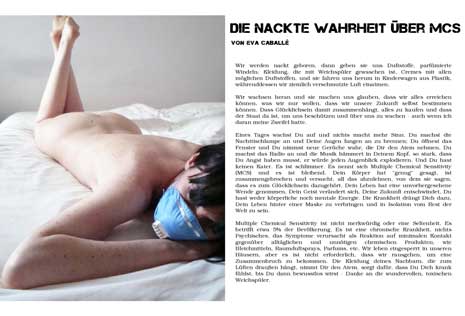

The naked Truth about MCS

from Eva Caballé

We are born naked, they give us cologne, perfumed nappies, clothes washed with softeners, creams with all kinds of possible aromas, and they drive us in plastic stroller while we breathe nice polluted air.

We grow up and they make us believe that we can achieve anything we want, that we can write our future, that the happiness is based in buy everything and the state is here to protect and watch over us, although I had my doubts.

One day, you wake up and nothing has sense. You switch on the table lamp and your eyes get burnt; you open the window and perceive new smells that don’t let you breathe. You turn on the radio and the music booms in your head, so much that you fear it will explode. And you don’t have a hangover. It’s worse. It’s been called Multiple Chemical Sensitivity (MCS) and has come to stay. Your body has said “enough”, has been broken and starts rejecting everything that they told you was essential for your happiness. Your life has taken an unexpected turn, your mind changes, your future vanishes, you don’t have physical nor mental energy. The disease forces you to live your life behind a mask and have been in isolation from the outside world.

Multiple Chemical Sensitivity is not strange, nor a minority. It affects to the 5% of the population. It’s a chronic disease, not psychological, which causes symptoms as a response to a minimal exposure to usual and unnecessary chemical products like bleach, air fresheners, perfumes, etc. We live locked in our houses but it’s not necessary to go out to have a crisis. Your neighbour’s cloths airing outside suffocate you, make you feel sick until you loose consciousness, thanks to the wonderful toxic softeners.

The World Health Organization (WHO) don’t recognize MCS as a disease yet, in spite of having in their possession innumerable studies that prove its existence and the European Parliament includes it inside the growing number of diseases related to environmental factors. The reason is the pressure that the chemical and pharmaceutical industry exerts for not recognize it, because MCS is caused by the chemical products that we use to consume. The economical interests in front of our health. In countries which this problem is recognized, like Germany, medical assistance and financial aids towards it are provided, and in some other countries it is being considered at the moment.

And what’s the situation in Spain? We don’t exist to our paternal government. On top of the drama of suffering MCS, they abandon us, without medical assistance and without any right to a disability benefit when we can’t work. They leave us naked and unprotected, like second class citizens, because we’re the evidence that the current model of society has failed, although nobody wants to see it or to take measures to sort it out.

They too steal any hopes we might have of feeling better. Pharmacists finance research only when they can obtain any profit. As a result of this, minority diseases don’t get research, not even MCS, which affect to the 5% of the population. The chemical and pharmaceutical industry knows that we get sick because we’re intoxicated and the key is not any medicine that will make them rich. The key is to change the model of this society, decreasing the big quantity of chemical products to which we’re exposed each day. Obviously, this can’t be known and they try to deny that MCS exists, because their economical interests would be at stake.

The chemical industry, supported by the government, doesn’t have the right to subjugate the population to the involuntary exposure to chemical substances, whose effects are often unknown. When we develop MCS, we must throw away perfumes, softeners, plastics, etc., to be naked again. We born again, but it’s a new life that we don’t choose. We know by the researches that have been done that MCS has genetic components, so not anybody could develop it, although this doesn’t save you to accumulate toxics until you have a cancer or any other disease related to environmental factors.

Those who suffer MCS want the disease to be recognized; we want to have the same rights as the other chronically ill people; we want society to know the risk they are under; we want the government to protect its citizens and prevent them from getting sick at no cost for them.


We don’t want anybody feeling naked again as a result of suffering MCS.


Photos and text published with author’s permission. Thank you very much Eva!

Foreword: Silvia K. Müller, CSN – Chemical Sensitivity Network, June 2009

Original Article “The naked Truth about MCS”

Canary Report: “The naked Truth about MCS”

Document and English translation – claissification of MCS as physical disease in Germany

Exposure to bitumen fumes and genotoxic effects on asphalt workers

Toxic fumes make asphalt worker sick

Bitumen fumes consist essentially of polycyclic aromatic hydrocarbons (PAHs) and their derivatives, some of which are known to be carcinogenic or cocarcinogenic in humans. The aim of this study was to investigate exposure to asphalt fumes among Turkish asphalt workers and determine whether any effects could be detected with genotoxic tests.  

The study included 26 asphalt workers and 24 control subjects. Sister chromatid exchange (SCE) and micronucleus (MN) were determined in peripheral lymphocytes. Urinary 1-hydroxypyrene (1-OHP) excretion was used as a biomarker of occupational exposure to PAHs.  

The asphalt workers had a significant increase in SCEs and MN (for each, p < 0.001). A positive correlation existed between the duration of exposure and rates of SCE or MN frequencies (r = 0.49, p < 0.05; r = 0.53, p < 0.05, respectively). The concentration of 1-OHP in urine was higher for the asphalt workers than for the controls (p < 0.001). However, we found that there was no statistically significant correlation between the urinary 1-OHP concentration and SCEs or MN frequencies (r = 0.25, p > 0.5; r = 0.17, p > 0.5, respectively).  

This study shows that Turkish asphalt workers have an increased exposure to PAHs from bitumen fumes, and genotoxic effects could be detected by SCEs and MN tests. 

Reference: Karaman A, Pirim I., Exposure to bitumen fumes and genotoxic effects on Turkish asphalt workers, Department of Medical Genetics, State Hospital, Erzurum, Turkey, Clin Toxicol (Phila). 2009 Apr;47(4):321-6.