The last few months of the life of Angelika S. who was chemically sensitive
Chemical Sensitivity – MCS is recognized as a disease and as a physical disability in Germany. The disease is coded at ICD-10 with T78.4 as an organic disease. One might think that people with MCS get proper medical treatment, are treated with fairness like other disabled people, get special workplaces and receive help. Sadly all of this is still lacking in Germany. People with MCS are left without medical attention and accommodations. If their families are unable to take care of them they are lost. For the very sick this sad and unacceptable situation can end in disaster as in the following authentic case.

The last few months of the life of Angelika S.
Six months ago Angelika S. was still doing fairly well. She lived with her family in a suburb of a German town. She loved animals and had a small animal hostel. She also cared deeply about other people.
I got to know her through my cousin who often visited her and mentioned four months ago that Angelika too had strange symptoms similar to my own. Suddenly, she didn’t tolerate fabric softeners – the shower gel of her family, the deodorants and a lot more now made her sick. My cousin told her about me and so we got in touch, first writing letters. She was looking for informational material about chemical sensitivity and I was sending it to her. About the same time I heard that she couldn’t tolerate the furniture and the flooring anymore and was sleeping on the kitchen floor on blankets. From now on everything went incredibly fast…
Nearly every day my cousin called me to report new intolerances. Because of the heat in August, she could only sleep outside on the patio on a kind of futon mat made from compatible materials. Then even this wasn’t possible anymore for her…
Calling an environmental doctor she was told, she would have to wait several weeks (vacation etc.). Then I could contact to her on the phone too. She was able to talk only five or seven minutes, because in addition now she had become electromagnetically sensitive.
Then I gave her the advice to drive to a nature area in her neighbourhood. She did so with her husband each morning between 7 and 8 o’clock. There she did much better. But it speeded up: difficulty in breathing… heart palpitations …. decreased muscle tonus in the arms and legs …. pulmonary problems …. everything took a turn for the worse.
Since she couldn’t use the phone anymore, I talked to her husband instead. In September he brought her to an abandoned campsite of his club and they slept in the car…in small cars…she in her car and he in his car because his one was contaminated with chemicals from his work. During the daytime he had to drive 25 kilometres to his workplace and to leave her alone there. In the evening he was cooking the meals for her and brought them to her… again 25 kilometres … The nights in the car… bad for the joints.
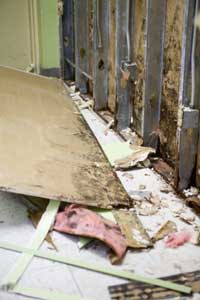
Then her husband called the environmental doctor again and got the advice to arrange a clean room for her in their house. He should tile the room and keep her in it. So he removed the floor, tiled the room and painted the walls with safe chalk paint. Angelika still was at the campsite, alone during the daytime and it started to get colder…Two air purifiers where bought from PureNature, oxygen for the ride to her home… and then the attempt to bring her back to the new safe room. During the whole time her husband had to take time off from work which got more and more difficult. They had to worry that he would lose his job too.
When she was back at home, my cousin couldn’t come for a visit anymore. Also no one from the family could come to see her. When her son came, she had to escape, and had no contact to her beloved grandchild.
I have had Multiple Chemical Sensitivity for over ten years now, but I had the chance to grow into the situation and I know what isolation means. The soul suffers…tears come…sometimes depression…and when there is no or little hope and you do not really know what will happen to you…then everything is even worse.
But Angelika was learning fast and tried to avoid everything which made her sick; she ate organic food and changed everything. But it takes time until all smells are out of a general household.
I supported her as much as I could by calming her down and providing her with information…Then the appointment with the environmental doctor came…He said that she has full blown Multiple Chemical Sensitivity and suggested a therapy only of B12 shots for six weeks daily with added B1 and B6. She started his therapy, but everything got worse.
Angelika had reached the end stage of Multiple Chemical Sensitivity in only six months.
When she still wasn’t doing so badly – that was in September this year – I had offered her a invitation to come to my place and try it here, but she wanted to try first the tiled room at home.
Last Saturday her husband called me to tell me that they had to drive to the forest or to a graveyard each night. Otherwise she wasn’t able to breathe…The heating period made the air in the town intolerable for Angelika. Each night she suffered from heart palpitations, shortness of breath and many more symptoms.
I told them to try to come over to me and so they arrived at nine o’clock Saturday, October 25th.
The last days of the life of Angelika S.
She arrived totally exhausted with a mask and heavy use of oxygen on the ride. We placed her on the porch.
For me her clothes were totally contaminated from her environment. I had to keep distance. Then she wanted to change her clothes. I offered her some of my clothes, but she couldn’t tolerate them. I had used an unscented safe washing powder which I tolerate very well.
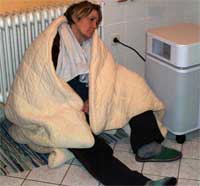 To let her into the house we had to shower her in the evening. I found old jogging pants of my husband’s and a cotton pullover; both had not been washed for a long time, and socks…
But on what should she sleep? She couldn’t tolerate wood anymore, no natural wood furniture. It didn’t matter if it was old or not. She even couldn’t tolerate the very old closet in the room we arranged for her. She wanted to sleep on the floor on linen which had not been washed for a long time and on a blanket which had been hanging in the attic for a long time too.
The windows to the forest were open all night and all day…
We live here in Germany in a wide forest area at Vogelsberg and so she was doing well with the clean air. However, last Monday it got damp and foggy and we had bad weather.
Her hope vanished that she would slightly recover here, but she wanted to try. She didn’t want to go back…
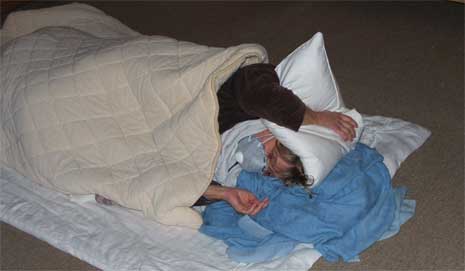
Either she lay or sat on the porch …. I cooked for her, gave her much water to drink …. tried everything possible to help her to restore her soul and mind …. told her about CSN and other sufferers who had recovered by avoiding substances and by isolating themselves. Each day we left for a walk in order to get some fresh air. So far she was still able to walk for an hour. On Tuesday, though slowly, she was able to walk until a car passed by and left exhaust emissions, which affected her in spite of her mask.
Then she said she couldn’t live a life as I do, without people around her and in isolation for such a long time and then it got worse and worse. She had no hope that she could stay here any longer because she couldn’t tolerate the damp air especially during the nights. She refused to eat or drink anymore. She was in despair and her mucous membranes were – as in her home – bright red and swollen.
She had to leave, but where to go????
We were considering many possibilities: Switzerland, North Sea…back to the campsite because there is not that much forest in its neighbourhood…setting up an aluminium shed…but how to heat it…and so forth…
On Wednesday at 3 o’clock p.m. the son of my cousin came with a big car which was safer than her car. Her husband and we said goodbye…
They didn’t know where to go…they didn’t know…what to do….so they first drove back to her tiled room and then to the close-by nature site.
She survived the ride at five degrees Celsius inside the car and then I heard nothing from them anymore.
On Thursday afternoon when her husband had to go to work and go shopping for food, she put an end to her life! I did not learn of it until Friday evening because it was the wish of her husband.
We are in deep grief about this lovely person…a human…who still could be living if there was accommodation for cases like hers in Germany. If there was just one clinic to go to which had clean rooms as at the Environmental Health Center in Dallas / USA. If we just had doctors who could diagnose chemical sensitivity in time. If we just had support for the relatives who don’t know why all this happens.
This ignorance and intolerance about environmental diseases MUST stop. These are diseases that have been described by scientists like Prof. Martin Pall and others. It’s well known what these diseases DO exist.
I have seen two suicides since last July.
- Two precious humans who didn’t know what to do because of their boundless despair.
- Two humans who felt as a burden to their families.
- Two humans who had worked hard all their lives.
We lament Angelika S. and we are shocked because of the lack of help for people with severe Multiple Chemical Sensitivity.
May the God of solace comfort the suffering of the relatives and may they find hope that their suffering is not forever…
That it will not be like this forever…
That the suffering stops some day…
And that some day there will be a recovery of all things lost…
Authors: Wolfgang and Mona B., Silvia, CSN – Chemical Sensitivity Network November 2009
- Japanese Version: “The last few months of the life of Angelika S.”
- Italian Version: “The last few months of the life of Angelika S. ”
- Spanish Version: “The last few months of the life of Monika S.”