Monthly Archive for March 2010

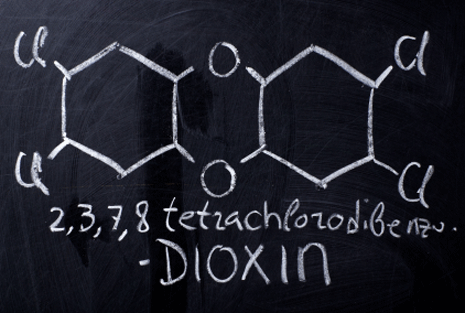
EFSA publishes European overview of dioxin levels in food and feed

The European Food Safety Authority (EFSA) has published an analysis of the levels of dioxins and related substances in food and animal feed. The report, which was prepared by EFSA’s Data Collection and Exposure unit, is based on over 7,000 samples collected by 21 European countries between 1999 and 2008. EFSA was asked by the European Commission to evaluate dioxin contamination levels in relation to maximum levels which have been set for different categories of food and feed in the EU in order to protect consumers.

Dioxins and similar compounds, such as dioxin-like polychlorinated biphenyls (PCBs), include a range of toxic substances which are formed by burning – e.g. through waste incineration or forest fires – and some industrial processes. Their presence in the environment has declined since the 1970s, following concerted efforts at the EU level.

Dioxins are found at low levels in many foods. They do not cause immediate health problems, but long-term exposure to high levels of dioxins has been shown to cause a range of effects, including cancer. Their persistence and the fact that they accumulate in the food chain, notably in animal fat, therefore continues to cause some safety concerns.

The highest average levels of dioxins and dioxin-like PCBs in relation to fat content were observed for liver and liver products from animals. The highest average levels in relation to total product weight were for fish liver and products derived from fish liver. In animal feed, the highest average levels were found in fish oil.

Overall, 8% of the samples exceeded the different maximum levels set out in EU legislation. However, some of these samples clearly originated from targeted sampling during specific contamination episodes. There were also large variations between different groups of food and feed in terms of the proportion of samples which exceed maximum levels.

The report concludes that no clear trend can be established regarding changes in background levels of dioxins and related substances in food and feed over time, as there were increases in some categories but decreases in others. Furthermore, occasional contamination episodes and a lack of information on which samples resulted from targeted or random sampling make it difficult to assess such trends.

The current EU method for measuring overall dioxin levels is based on toxicity values for different types of dioxins recommended by the World Health Organisation (WHO) in 1998. EFSA was also asked to assess the impact on total dioxin levels of using toxicity values set out in WHO recommendations from 2005, which downgraded the relative toxicity of certain types of dioxins. The report finds that using the new values would reduce overall dioxin levels by 14%, although the extent of this reduction was very different across food and feed categories.

Finally, the report recommends continuous random testing of a sufficient number of samples in each food and feed group to ensure accurate assessments of the presence of dioxins and dioxin-like PCBs.

Author; EFSA, EFSA publishes European overview of dioxin levels in food and feed, March 31, 2010

Breathe easy: A natural fruit compound may help asthma

A preliminary study by New Zealand company Plant & Food Research shows that natural chemicals from blackcurrants may help breathing in some types of asthma.

Researchers found a compound from a New Zealand blackcurrant may reduce lung inflammation with a multi-action assault in allergy-induced asthma. The compound was found in laboratory experiments to enhance the natural defence mechanisms in lung tissue by both suppressing inflammation-causing reactions and minimising inflammation.

The findings are published in the journal Molecular Nutrition and Food Research.

Fruit consumption has been shown to reduce symptoms in allergy-induced asthma yet this research is the first to give insights into the mechanism by which this may occur. The researchers identified that the component, epigallocatechin, reduced inflammation in lung tissue. Epigallocatechin is a known antioxidant and a major component of proanthocyanidins found in blackcurrants.

In the Plant & Food Research study, led by Dr Roger Hurst, cells from lung tissue were used to test the effects on the immune system of a proanthocyanidin rich extract, from blackcurrant cultivars grown in New Zealand.

When the lungs are exposed to allergens, the body’s natural response is to attack the perceived foreign body which in some individuals results in long-term inflammation. Selective compounds found in fruit and vegetables may work together with the body’s own natural defence mechanism to suppress long-term lung inflammation.

This study shows that epigallocatechin, from blackcurrants, works in conjunction with other natural immune responses that occur at the same time to reduce inflammation. These actions are distinct from the inflammation-reducing activity of another group of compounds, anthocycanins, which are also rich in blackcurrants. Anthocyanins are known for their antioxidant properties and, interestingly, have been shown by Dr Hurst’s research group to also influence inflammatory mechanisms and complement the body’s own natural immune responses. The research shows some compounds in fruit thought to promote health with their antioxidant activity are keeping us well by other means.

“To find natural compounds that potentially reduce lung inflammation and complement the body’s own immune response is an exciting breakthrough,” says Dr Hurst. “Should we discover more about how this works we may eventually develop foods containing these compounds that could provide more natural alternatives to assist conventional drug treatments for asthma and even other allergic re-actions.”

The study is part of Plant & Food Research’s Food Innovation science platform that focuses on discovering the natural goodness in fruit, vegetables, grains and seafood and using this knowledge to develop fresh whole foods, ingredients and food concepts. Dr Kieran Elborough GM Science Food Innovation says research is improving the understanding of food and its makeup, how it benefits us and the development of new value technologies, ingredients and products.

“Maintaining wellness in a natural way is a growing consumer trend that food companies recognise, “says Dr Elborough. “New Zealand is well known for its quality fresh produce and I am quietly confident our understanding of natural compounds in fruit, vegetables, grains and seafood has good potential for food and beverage companies.”

Literatur: New Zealand Institute for Plant and Food Research, Breathe easy: A natural fruit compound may help asthma, March 25, 2010.

How to become an MCS activist in less than 365 days? Have look to Spain

People from all over the world with chemical sensitivity have understood that their illness is a matter of policy, suppressed by certain lobbyist groups and industries so as to not lose their influence and revenues. For decades, these groups have succeeded in explaining chemically caused diseases as not existing and denouncing the afflicted as mental wackos through specific propaganda. Thanks to the internet, these structures are starting to crumble. The MCS-diseased network internationally, exchange expertise and encourage each other. The possibilities offered by social networks are multiplying this. Years ago barely none of the afflicted knew someone from another country, yet today this networking has turned the world into a “village”.

Never would I have gotten in touch with Eva, a young Spanish Lady who suffers from severe chemical sensitivity, extreme nutrition intolerances and CFS. Even if I had traveled to Barcelona where she lives, I would have never been able to meet her. For the past two years she only can stay in her home, and for several months she just lies in bed all day. In defiance of her severe illness, this remarkable activist manages to make the people of her country aware that our hyper consumption of chemicals in everyday products takes its toll. Together with Susie Collins from the U.S. Canary Report, I asked Eva to report on the last few months. This wish was important to both of us, because from Eva’s report other MCS-afflicted should take heart to become active.

Nobody expects that every sufferer of chemical sensitivity will achieve as much as that which can be read in the following report. It’s even not necessary, because there are many individuals throughout the world who have the same target – the acceptance of a disease which is not allowed to be, but which can’t be kept a secret any longer.

On the other hand, “never say never”, because you possibly may be somebody who still has good ideas and guts, even if you are only able to stay in bed and lack vigor. There sleeps more potential capacity in us as we reckon by ourselves. The intention of the following report is to inspire you:

Eva Caballé:

My friends Silvia Müller and Susie Collins asked me to write about all the Multiple Chemical Sensitivity awareness events I have done since June 2009. This is a summary of all my articles, collaborations and media appearances, which I hope have helped raise MCS awareness.

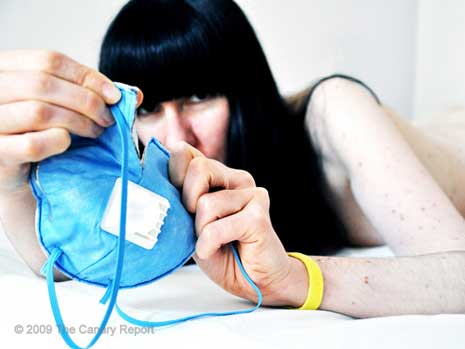
As many of you know, last June, I wrote an article called “The Naked Truth about MCS” for the on-line cultural magazine Delirio, with two photos of me naked wearing nothing but a mask. The article was translated into nine different languages, thanks to Susie Collins at The Canary Report and Silvia Müller at CSN – Chemical Sensitivity Network. Since then I have contributed to each edition of Delirio with articles focused on MCS: “Screaming from the Silence” and “Metamorphosis inside MCS”, and I am now working on the next one.
Then I decided to write a book to let people know, through my personal life and experience, what it’s like living with MCS: the total abandonment that we suffer and why people should be worried about all the toxic products they use daily. I finished writing Missing: A life broken by Multiple Chemical Sensitivity at the end of August, and in November the book was published by El Viejo Topo. The book was announced when Salvador López Arnal interviewed me to talk about MCS, an interview that was then translated into English, Japanese and German, thanks to my online friends.

Thanks to “The Naked Truth about MCS,” I met a lot of interesting people from all around the world, and one of them in Japan, Takeshi Yasuma, from Citizens Against Chemicals Pollution (CACP), asked me to write a message to MCS patients and their supporters to be presented at the symposium in Celebration of the Recognition of MCS in Japan in October 2009. My message was read and displayed during the symposium.

In November, two weeks before my book was released, I was interviewed by phone at Radio 3 (National Radio in Spain), in a live culture program at prime time called Carne Cruda. For 25 minutes we talked about Multiple Chemical Sensitivity and my book, and they were so shocked that they promised me they would contact the Ministry of Health to explain to them the terrible situation of MCS sufferers. As many of you know, the Secretary General of the Ministry of Health was interviewed on air (my husband David talked to him on my behalf) and made a public commitment to meet MCS associations in Spain to listen to our claims. The meeting was held on February 4, 2010, the outcome of which was a commitment by the government to form a Scientific Committee to create a document of consensus on MCS.

At the end of November, an article about my blog No Fun was published in the youth supplement of the printed newspaper Deia. The article, entitled “Toxic Life,” was an extensive and accurate analysis of my blog (the information I provide, the translations I make, the articles I write, my collaborations, etc.), with focus on MCS and my collaborative work in the international fight for MCS awareness.

I also participated in the fabulous Canary Report 2010 wall calendar, with 14 other women from all around the world. The idea was inspired by my nude photos published at Delirio and I was very proud to be part of such an amazing project led by Susie Collins. The calendars are available for purchase and all profits are donated to the Environmental Working Group.

At the end of 2009, Salvador López Arnal interviewed me again, this time we talked more about my book and my experiences, and he also interviewed my husband David, who wrote the epilogue of my book. This interview was published in the printed magazine El Viejo Topo in January, and in February was released online.

During December 2009 and January 2010, three fabulous reviews of my book were published. The first one was published at Punts de Vista, a blog by Àngels Martínez i Castells, who is an economist and the president of Dempeus, a Catalan association in defence of public health. The second one was published at Kabila, a blog by Rafael G. Almazán, who is a journalist specializing in political and human rights. And the last one was published at the website of the environmental journalist and writer Miguel Jara.

At the end of January, another interview of me was published in the Health supplement of ABC, one of the most important printed newspapers in Spain. The interview, which was a double page and included a photograph of the cover of my book, was focused on MCS and my experiences explained in my book, but also focused on the total abandonment that people with MCS suffer. They included an MCS article written by Dr. Arnold, an immunologist specializing in MCS, which was also published at the website of the newspaper.

“El color de la tarde,” a magazine radio program on Radio Intercontinental, asked to interview me the day after the interview at ABC was published. I wasn’t able to do it because of my health condition, but they agreed to interview David on my behalf. The interview was focused on MCS and my book.

Also at the end of January, an article was published at El Observador magazine entitled “The canary of the mine.” This article, inspired by my book, was about MCS, toxics, my book, and Silent Spring by Rachel Carson. The article was written by an ecologist and it was very combative, encouraging lectors to become aware of the alarm from people with MCS. The article was finished with one paragraph of my book and the last sentence was: “Maybe so many toxic products have managed to turn us into sheep?”

In February, my book was mentioned in a literary radio program at Radio Euskadi and because of this, “La noche despierta,” another program of the same radio, asked to interview me by phone to talk about my book and MCS. My health didn’t allow me to make this interview but they agreed to interview David, my husband, because they were very shocked about my book. The interview with David at Radio Euskadi lasted 30 minutes and it was very deep and sensitive. They talked about MCS, how our government doesn’t do anything to help us and how are we doomed to live without support from social services. The journalist had an exquisite tact and the interview was moving. I answered one question that I previously recorded from bed.

In March, my book was added to the catalogue of two public libraries: Public Library of Navarra and Public library of University of Alicante. I am very excited about this because in both public libraries it’s the first book about MCS that they have.

Also in March, an interview with David was published at “La Contra,” a prestigious section of a very important printed newspaper in Spain: La Vanguardia. They wanted to interview me, but because of my health condition I couldn’t do it. The interview was about MCS and our experience and it was a great success. Because of it, another radio program has asked to interview David.

The same day of the interview at Radio 3, a Spanish filmmaker contacted me because he was shocked with the interview and he decided to make a short film to help to raise MCS awareness. He asked me to help him, because, even though the history would be fiction, he was very interested to make it as real and accurate as they can. The short film about MCS, entitled Los Pájaros de la Mina (The Birds of the Mine), has started to film in March and it’s raising much expectation, talk and press because it will be the first MCS short film in Spanish.

A national TV program called Terra Verda (Green Earth) asked me to participate in their program dedicated to toxics at home. Because of my health condition, they couldn’t come to my house but they agreed to have David record my interview with our video cam. They also asked us to show the changes we have done at home because of my MCS, and we did a second video showing all this information. This program will be aired at the end of March, and then I will post the program at my blog No Fun, along with the full-length version of both videos we recorded at home.

All this has happened in less than a year! I’m very excited about it because I could never imagine I would be able to do all this, especially when my health condition worsened. Of course I couldn’t ever do any of this without the help and support of David and all my family and friends from all around the world.

Author: Eva Caballé, No Fun, March 2010

Title Photo: Canary Report Calender 2010 – thanks to Susie for the permission

The Psychogenic Thesis for Environmental Diseases – No Value for Science, Destructive for Legal Rights

As an explanation of environmental illnesses the psychogenic thesis is nothing but bullshit

The psychogenic thesis was introduced to the discourse on environmental illnesses only once the prevalence of these diseases was already quite high. It was originated in the 90s. Publications about TE – toxic encephalopathy – can be traced back to 1904, MCS was discovered in 1945. The scientific contribution of the psychogenic thesis was next to nothing; however the harm to legal rights was immense. It was not initiated despite its recognition but because of the recognition as an organic illness by the WHO (ICD-10 code for MCS: T78.4). Keep in mind: In about 1996 they tried to rename MCS in IEI (Idiopathic Environmental Intolerances).

This is no scientific debate, it’s plain jurisprudence. All western civilizations are based on the human rights, which are declared in particular Constitutions and which must be met by their subsequent laws. Therein health is a big legal value. E.g. physical integrity is explicitly protected in the German Constitution in article 2.2. This legal protection is undermined by the psychogenic debate, because legal protection is not granted for imaginary ills or other wackos. Thus the psychogenic thesis serves to steal the rights of the diseased. That’s its main purpose. Whether for insurance or damages the victims fail judicially. That they do not receive any adequate medical care for this reason is in some manner of speaking a collateral damage.

You are right, if you find this to be outrageous because the psychogenic thesis makes use of the fact that neurotoxins damage mental brain functions. This mental dysfunctions from neurotoxins were already defined 1985 in the diagnose criteria for TE (WHO). Cause and effect were simply swapped. They can make as many studies as they want and find what they expected: psychological disorders. That they are from another structure than known psychological diseases is suppressed or is not evaluated thoroughly enough. Because of that, the psychogenic thesis is no scientific finding. Because the effects of neurotoxins for the psyche were already well-known. Therefore the analysis is always bogus.

This is something with no term in German. The English language offers several possibilities, namely fake, bullshit or phoney. The moral philosopher Harry G. Frankfurt (Prof. emerit. Princeton) has analyzed such terms philological philosophic. “On Bullshit” became a bestseller. Referring to that the substance (a term from philosophy) of bullshit is the absence of correspondence to reality. A lie can be caught: a detail in an arrangement of facts (findings) altered intentionally. This can be verified. Bullshit is a invention, free from the annoying study of reality (maybe science). The psychogenic thesis is bullshit, the invention consists of swapping cause and effect. If somebody tries to refute it scientifically, he already confirms the main intention of the bullshit, to fake science. Parameters from the laboratory will not help. Because “bingo!” the item has changed and a phantom debate takes place. H.G. Frankfurt says: Bullshit causes more harm than lies. It damages all findings, not only in detail. Until now, this was always the case in the psychogenic debate: as soon as the term psychosomatic medicine was mentioned, the discussion instantly focused on it exclusively.

You cannot disprove bullshit scientifically, only debunk it. In his 2009 paper Prof. Pall specifies of the psychogenic thesis. Thus he risks his clarification of the basic biochemical pathomechanism is also buried in oblivion, and thus the discussion is pushed away again. This has worked well over the last decades. The German RKI-Study “found” that the mental scores of MCS patients differ from the ones of psychiatry patients. Already two years later this annoying detail was forgotten. Since the 80s we know exactly about the nature of MCS. However bullshit is discussed more frequently than the item. There is no reason to be astonished.

Bullshit damages more: even humans. A phrase of a German Constitution expert goes like this (logical): “It is the most perfidious kind of genocide, to leave those on their own, who are unable to help themselves.” He didn’t mean the diseased (in 1954). But today, instead of race or religion, individuals with wrong genes – the bad detoxifier – were rendered to substandard persons (ecochonder is one of the inventions). That’s truly perfidious.

This can only be changed, if we understand that this is a matter of law and not science. The scientific case is decided since decades. We have to realize that scientific decisions generate a legal effect by the legal concept of “recognized state of the scientific knowledge”. The intention exactly is to avoid this legal effect. The psychogenic thesis accomplished this quite effective, so far. It only takes changing the item, to invoke a pseudo debate, and instantly MCS is unknown, mysterious and also not recognized by the WHO. This allows the undermining of law and justice. Committed appraisers argue scientifically than to abide by the state-of-the-art of science, what in fact is their job. And the patient organizations also struggle for scientific findings, which are all known – and recognized! This allowed the bullshitters to always succeed without much effort.

There only will be a change if those who want the change take courage to call bullshit really bullshit and not to be intimidated by the arrogance of exclusive interpretive sovereignty, according to Frankfurt, always an attribute of bullshit. The weapon against is the argument, that the point is physical integrity or in other words bodily injury. The psychogenic thesis abets physical injury.

Author: Dr. Tino Merz for CSN – Chemical Sensitivity Network, March 12, 2009

Translation: BrunO / Thanks for proofreading and help: John

Pyrethrins and pyrethrosin content in commercial allergen extracts

Pyrethrins are the insecticidally active components of pyrethrum extract, derived from flowers of Chrysanthemum cinerariifolium and used in commercial and consumer insecticide products. Most dermal testing performed with pyrethrum extracts was done before current refined pyrethrum concentrate became available (before 1967).

A group of  Scientists analyzed presently commercially available pyrethrum allergen extracts to determine the concentration of pyrethrins and the putative sensitizer pyrethrosin.

Six commercial pyrethrum allergen extracts were purchased from four major allergen suppliers and analyzed for pyrethrin I and pyrethrosin by using a capillary gas chromatograph equipped with a flame ionization detector.

The commercial pyrethrum allergen extracts contained no detectable pyrethrins or pyrethrosin. In comparison, the pyrethrum standard provided by the McLaughlin Gormely King Company, a major refiner of pyrethrum, contained 20% pyrethrins and 0.49% pyrethrosin. No compounds observed in the chromatogram of the refined pyrethrum concentrate were present in the allergen extracts.

Caution should be used when interpreting the results of tests performed with current pyrethrum allergen extracts because pyrethrins and pyrethrosin may not be present. Moreover, unknown components such as high-molecular-weight proteins or other impurities that may cause dermal reactions could be present in significant amounts.

Literature:

Osimitz TG, Franzosa JA, Maibach HI., Pyrethrins and pyrethrosin content in commercial allergen extracts, Dermatitis. 2009 Dec;20(6):338-40.