Martin Pall about genetic evidence and Multiple Chemical Sensitivity
Studies show chemicals act as toxicants in causing cases of Multiple Chemical Sensitivity; genes that metabolize these chemicals into other forms influence, therefore, susceptibility to getting MCS.
Guest post at Canary Report by Martin L. Pall, Professor Emeritus of Biochemistry and Basic Medical Sciences, Washington State University and Research Director, the Tenth Paradigm Research Group.
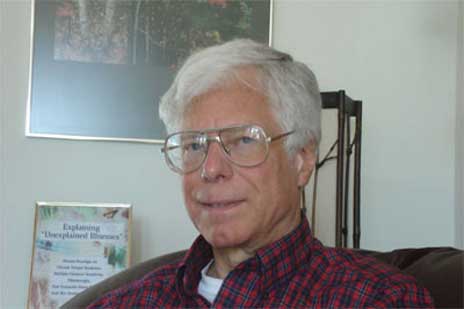
Martin Pall: I have emailed the following as an open letter to the Denver Post in response to the article on multiple chemical sensitivity (MCS) that was published this weekend. I think the published article was generally a step forward in terms of public understanding of MCS. But the article left out a number of important things and this letter is an attempt to deal with some of those. I have asked them to consider publishing this as an Op-Ed piece, but wanted to make it available regardless of whether or not they opt to do so.
Thank you for writing this article on multiple chemical sensitivity (MCS), the term that is used in most of the scientific literature on this disease. There are vast numbers of people who have been afflicted in this epidemic of chemical sensitivity and I am sure that they are all thanking you. I also thank you for mentioning a bit of my work on this disease.
Some of your readers have already made quite a number of important points about MCS so I can focus here on just a few remaining issues. How do chemicals act in MCS? We know now that the seven classes of chemicals implicated in MCS all produce a common toxic response in the body, excessive activity of a receptor in the body called the NMDA receptor. So even though we have a vast array of such chemicals, we know how they can produce similar responses in people.
There is compelling genetic evidence that these chemicals act as toxic agents (toxicants) in the body. Four such studies have been published by three research groups in three countries. Collectively they implicate six genes as influencing susceptibility to MCS, such that people carrying some forms of each of these genes are more susceptible to becoming chemically sensitive than are people carrying other forms of the same genes. All of these genes control the activity of enzymes that metabolize these chemicals into other forms. Most of these studies show a high level of what is called statistical significance. In the Schnakenberg and colleagues studies, the chances of getting their results by chance are less than one in a million billion. So obviously, these are not chance results. What these studies show is that chemicals are acting as toxicants in causing cases of MCS and that genes that metabolize these chemicals into other forms influence, therefore, susceptibility to getting MCS. These studies, then, provide compelling evidence that cases of MCS are caused by toxic chemical exposure. Clearly they also show that MCS is a real disease, otherwise one would not be able to do such studies clearly linking the chance of becoming ill with MCS to the action of chemicals acting as toxicants.
Dr. Herman Staudenmayer has, for some 20 years claimed just the opposite. He claims that MCS is psychogenic, caused by psychological responses and according to him, is not a toxicological phenomenon. He has maintained this claim by ignoring contrary data wherever it occurs. He has ignored all of the evidence that chemicals implicated in MCS produce a common response in the body; he has ignored the roughly two dozen studies showing that MCS patients show objectively measurable responses to low level chemical exposures, responses that differ from those of normals. He has ignored all of the evidence implicating excessive NMDA activity in MCS; he has ignored the dozens of animal model studies on MCS; he has ignored over 50 studies that show that cases of MCS typically occur following chemical exposures; he has ignored the various other measurable physiological changes reported to occur in MCS. This has all been documented in my book “Explaining – Unexplained Illnesses” and in my article on the toxicology of MCS that is coming out next month in a prestigious reference work for professional toxicologists “General and Applied Toxicology, 3rd Edition”. It is also documented on the MCS web page of my web site: The Tenth Paradigm
Clearly you cannot do science by simply ignoring the existence of vast arrays of contrary data. However, Staudenmayer provides us with a couple of other tests of his views in his book, predictions that allow us to test his theory. He predicts that psychological factors are necessary and sufficient to account for the properties of MCS. This, of course, is contradicted by all of the evidence I referred to earlier. Therefore we should reject his hypothesis based on his own prediction. He provides a second prediction as well (the exact quotes from his book on these predictions are provided on my MCS web page). He predicts that the variation of susceptibility to MCS is not caused by variable responses to toxic chemicals. Clearly the genetic studies discussed above have shown that this is false and therefore, his hypothesis should be rejected for that reason, as well.
It is clear, from the above, that Staudenmayer’s construct was basically a house of cards. Now that it has collapsed, where does that leave us?
Firstly it leaves us with reversing the errors of the past. We need to start treating MCS sufferers as victims of unsafe chemical exposure. Many of them have previously been used, abused and discarded. If we live in a society where people are not disposable items we need to “do unto others as you would have others do unto you.”
We obviously need to start regulating chemical usage much more carefully, to avoid initiating new cases of MCS. It is imperative to develop tests for chemical activity in MCS, just as we have developed tests for chemical activity as carcinogens. Then we need to use these tests to effectively regulate the use of toxic chemicals.
We need to develop specific biomarker tests for MCS, tests that can be used to objectively confirm diagnoses initially based on subjective symptoms. I think we already have several very promising approaches to doing this in the scientific literature and a minimal amount of further study may be all that is needed to develop such tests.
We need to confirm that chemical avoidance is key to therapy and to develop other therapeutic approaches to work along with avoidance. The environmental medicine physicians and others have already made very important progress in this direction and I am optimistic that further progress can be made quickly. Such progress is relevant not only to the treatment of MCS patients but also to the treatment of clearly related diseases including chronic fatigue syndrome/mylagic encephalomyelitis and fibromyalgia. All of these diseases are caused by what I have called the NO/ONOO- cycle and the way to treat them, in my judgment, is to lower the activity of that vicious cycle mechanism.
Martin L. Pall
Professor Emeritus of Biochemistry and Basic Medical Sciences, Washington State University and Research Director, the Tenth Paradigm Research Group
Reprinted with permission from the author. Dr. Pall cautions the reader that he is a PhD, not an MD, and none of this should be viewed as medical advice.
- Original Article posted by Canary Report Thank you for the permission to reprint Susie!
- Link to Martin Pall’s website: The Tenth Paradigm
- Link to an extended excerpt from Palls book Explaining “Unexplained Illnesses.”